In this video
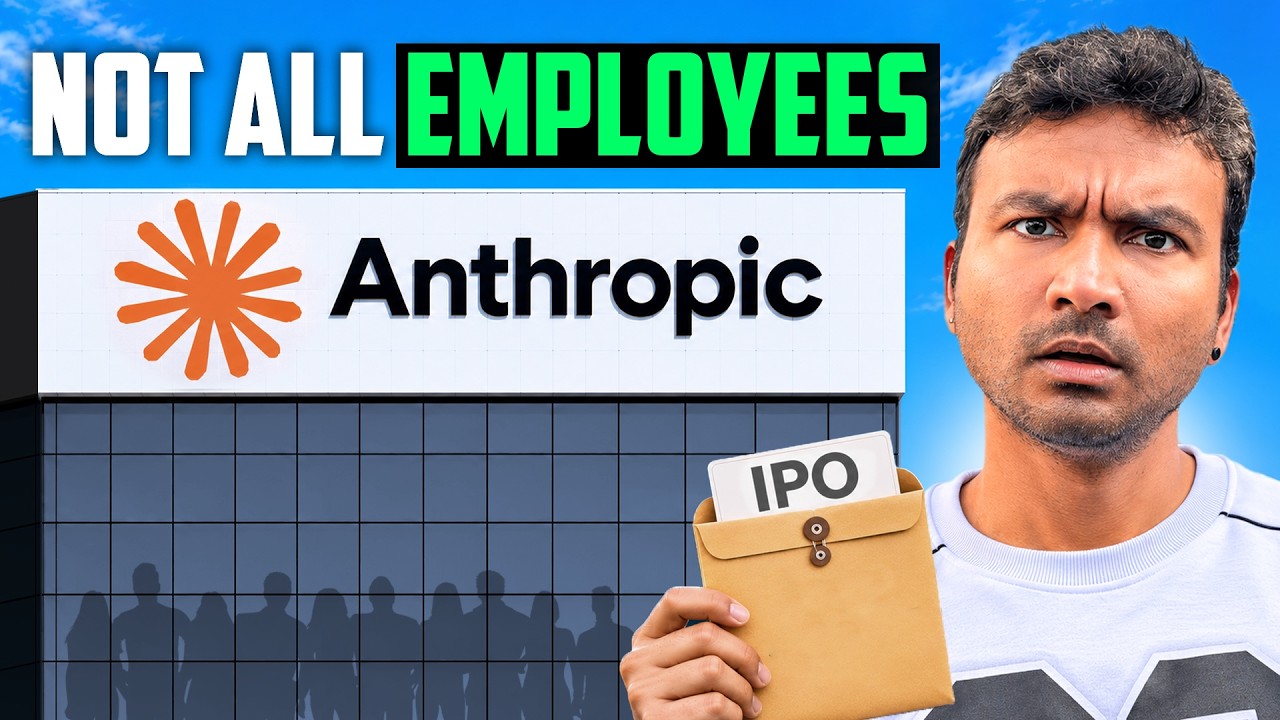
When Anthropic went public, the headlines promised thousands of millionaires. Magesh was an engineer on Nextdoor's ads team when Nextdoor went public in November 2021, and he watched the same math play out from the inside. On IPO day everyone pulled out their calculators, and that math was wrong for two reasons. First, employees hold stock options, not shares: what they make depends on their strike price, and only on what has vested. Second, Nextdoor employees couldn't sell for the first 180 days, and by the time the lockup ended the stock had fallen far below its first-day high. He explains how Anthropic's deal is different (employees could sell 10% on day one), who really gets rich from an IPO, and three questions to ask before you join a pre-IPO company.
Key takeaways
- The headline math is wrong. Multiplying your stock options by the share price on IPO day is not what ends up in your bank account.
- Stock options are not shares. An option is the right to buy a share at your strike price. Join early and the strike price is low; join late and it's high. Your number is the share price minus the strike price, minus taxes, and only on vested stock.
- Vesting and the one-year cliff. The most common schedule in Silicon Valley is four years. You get nothing in the first year (the cliff), then usually quarterly or monthly chunks.
- You may not be able to sell. Nextdoor employees couldn't sell anything for the first 180 days. By the time the lockup expired, the stock had fallen far below its first-day high, and Magesh barely made any profit.
- Anthropic's deal is different. Anthropic employees could sell 10% of their stock on day one of trading. The other 90% is still locked up.
- Early investors and founders do best. They got in at the lowest price, so even if the stock drops by half they are still fine. Investors also get many chances; employees usually get one or two.
- Late employees have the least room. Joining close to an IPO means unvested options, a high strike price, a lockup and taxes.
- He'd still do it again. Magesh learned a lot from his first IPO as an employee and says he would totally do it again.
Chapters
Frequently asked
What questions should I ask before joining a pre-IPO company?
Magesh's three: What is the strike price of a share? What is the vesting schedule? And if you're close to the IPO, when can I sell?
What is the difference between a stock option and a share?
An option is the right to buy a share at a set price, the strike price, and you haven't bought it yet. Your profit is the share price minus the strike price, minus taxes, and only on the options that have vested.
Can employees sell their stock on IPO day?
Often not. Nextdoor employees couldn't sell anything for the first 180 days. Anthropic was different, with employees able to sell 10% of their stock on day one and the rest locked up.
Who gets rich from an IPO?
In Magesh's view, the early investors and founders first, because they got in at the lowest price. Then early employees who waited out their vesting. Late employees, and people buying in the open market, have much less room.
Transcript
0:00 Thousands of millionaires. And I have been one of those employees. Multi-millionaires.
0:05 So who really gets rich during this IPO? Everybody was doing that math and that math was wrong. These are stock options, not shares. So explorers, if you are joining a pre-IPO startup company, I want you to ask these three questions.
0:21 A few days ago, Anthropic went public. Biggest IPO in the history. And the news headlines are everywhere. Thousands of millionaires, millionaires, into millionaires.
0:30 And I have been one of those employees, not at Anthropic, but in another company called Nextdoor. On the day of the IPO, I was an employee at this company. And 6 months later, when I finally could sell the stock, I barely made any profit. Explorers, in this video, I'm going to explain what exactly happens to an employee when a company goes public. What are stock options, and why the news number that you see is not in the bank account, and how Anthropic's deal is different, because Anthropic employees could sell 10% of their stock on day one of trading. So, before this video ends, you're going to learn what stock options are, how you can make a profit as an employee, and what questions you should be asking a recruiter if you are joining a pre-IPO company. If you are listening on Spotify while driving, please keep your eyes on the road. Eyes on the road, explorers.
1:13 So who am I to talk about all this? I was an engineer at Nextdoor. More particularly, I was in the monetization team. It was the ads team. We were building a brand new ad stack at that time, and this is primarily the money-making team before going public.
1:26 And yes, we'll keep investing in our proprietary ad tech stack.
1:30 And that ad stack, that's our team. And I was also one of the people who was responsible for building the pipeline that was moving the data from our engineering team, the credit card processing data, all that information, to the accounts team. And then in the accounts team, they were reconciling all this and making sure these numbers are right. And I was one of the people who was leading the SOX compliance from the Nextdoor side. Don't worry if you didn't understand some of the words that I mentioned so far. In the next section of the video, I'm going to clearly explain how an employee goes through an IPO and makes money in the process.
2:00 The IPO day at the office. So on the day of the IPO, November 8, 2021, almost all the employees were gathered here at the office in San Francisco. You want to say hi? And the leadership team of the company, they flew to New York for the opening bell. And the excitement was real. How is the stock price going to go? And almost all of us had stock options at that time. I'll explain what stock options are in a minute. And look at all these faces. Some people were working in the company for so many years, and this is the day they were all waiting for. And quiz time, can you guess which celebrity investor invested both in Nextdoor and Anthropic? And the answer is Ashton Kutcher. Yes, the Hollywood actor Ashton Kutcher invested both in Anthropic and Nextdoor. The opening bell rang and the stock opened at around $11, and it kept going up all the way to $18.59. Almost all of us had our calculators out at that point. So I'm just going to give a quick example, not the real numbers, just an example.
2:56 Imagine an employee inside the company at that time had 100,000 stock options. Each stock is worth $18.59. What that means is the total value of the stock options is $1.8 million. Everybody was doing that math and that math was wrong. I did that math too, and it was wrong for two reasons.
3:16 Reason number one, these are stock options, not shares. What are stock options? An option is a right to buy a share, and you haven't bought it yet. If you join a company early, your strike price is low. And if you join a company late, your strike price, that is the buying price of the stock, is very high. If you're confused, I was confused as well. Let me explain that with an example. Let's just say on the day of the IPO a stock is trading at $10, and an early employee joined the company as soon as it was started. On the day they joined, they were given the strike price, which is the buying price, and the strike price was one single dollar. Just $1.
3:58 If they had the option to buy 100,000 stocks, they would buy each stock with one single dollar. So that is $100,000 of expenditure, their own money they have to spend to acquire that stock, and the stock is currently trading at $10 per share. So they are making $9 of profit on each share. You're with me so far, right? So another employee joins very close to the IPO, just like one year or 6 months before the IPO, and the strike price they would be given probably is $9 per share, and the stock is currently trading at $10. So the profit is just one single dollar. And imagine what happens after the IPO. The stock is volatile. It could go down. Let's say it goes down to $8. Now that stock is worthless, because why would you buy something for $9 that you could sell for $8?
4:45 If you did not understand that, I want you to rewind for like 30 seconds or 1 minute and hear that again. You need to understand what strike price is for the next section. The next part is called vesting. In Silicon Valley, the most common thing is a 4-year vesting period. That means if you join just one year before the IPO, you only get a quarter of your stock options. And if you just joined 6 months before the IPO, you don't get anything yet. You need to wait at least 1 year for those options to be yours. If you get fired before 1 year, you get nothing. Just the salary, the base salary, that is yours. That's paid monthly. And that vesting schedule is usually, like I said, four years, right? The first year is called a cliff. You don't get anything in the first year. But after that, it's usually either quarterly vesting or monthly vesting. You get it in chunks every month. All right. To summarize, your number is the share price minus the strike price, which is what you pay, minus the taxes, and all of that only on the vested stock.
5:38 Nobody puts that in the news. That's not in the headlines.
5:41 Reason number two, you cannot sell. You heard that right. As employees of the company, on the day of the IPO, we could not sell any of the shares. I mean, at least in my case, but in Anthropic's case, it was different. The employees could sell 10% of the stock on day one. 180 days later, they could sell everything. But in Nextdoor's situation, my situation, for the first 180 days of trading, we could not sell any of our stock. So we watched as our numbers came down. It started off at $18.59, and by the end of November it was $11, and by the end of March it was $6, and finally, when the lockup period expired on May 4, 2022 for the employees, our stock was worth around $4. And it kept going down, and 5 days later the stock was worth $3.33.
6:25 By the end of that year, the stock was worth $2. Just $2 a share. We started at $18 and it was worth $2, in not even a year and a half. And the day that I finally could sell my stock, I barely made any profit. And imagine people who joined late, they could barely make anything at all. And that $18 that we saw on the screen, it was never ours. It's just a number on the screen. But I learned so much from this IPO. This was my first IPO experience as an employee, and I learned so much, not just me, so many of us building the company all the way up to the IPO. So if you were to ask me, would you do it again? I totally would.
7:00 How is Anthropic's deal different? Like I said before, Anthropic employees had 10% they could sell on day one. The 90% is still locked in. It could go either way, like it could go up or down. Nobody can predict the future. Their IPO price was $83, and then it was trading at around $100 when I bought it.
7:19 So who really gets rich during this IPO? Number one, the early investors and the founders, because they got in at the lowest price. So even if the stock goes down by 50%, they are still fine. So let's look at Ashton Kutcher. He invested around $400 million in 2023, and that is now worth $7 billion. From this tweet, you can see he is congratulating all the LPs, which is limited partners. So it's not all his money. The investors have given him money, and he has invested into the company through his venture firm. So you can notice a pattern here, right? A big investor like Ashton Kutcher invested in my company Nextdoor during my IPO, and then he did that again during the Anthropic IPO, and he seems to be repeating it.
8:02 The investors have more chances, but the employees usually get one or two chances. So that brings us to the early employees. You have to join a company so early and wait for years, like 4 years, for the vesting to be completely over. Only then can you think about another company. So you are kind of locked into one company. And number three is the late employees who join very close to the IPO. So it's not vested. The strike price is high, and it's locked and taxed. So there's very little scope if you join very close to the IPO. I mean, some of them do well, some of them do very little. And number four, you and me, buying the stock in the open market. I bought it for $100, and it had already gone down. Again, I'm not a financial adviser. This is not advice, only an analysis. And feel free to correct me in the comment section if any of what I said is wrong.
8:48 And I bought Anthropic stock only to make this content. I'm not recommending it, I'm only disclosing that I bought Anthropic stock.
8:55 So, explorers, if you are joining a pre-IPO startup company, I want you to ask these three questions. What is the strike price of a share? What is the vesting schedule? And if you're close to the IPO, when can I sell? You have to ask these three questions for sure. And there are more questions you should be asking. I'll leave them in the description. And mark your calendars for May 18, 2027. That's when the 180-day clock expires for Anthropic employees, who can start selling everything. And we'll find out if the headlines are right. If you have gone through an IPO as an employee, I would like to hear from you. You can either comment, DM me or send an email to ipo@hobbyexplorer.com.
9:34 All right, explorers. Stay curious, but don't stay hungry. I'll see you again tomorrow in another video.
Source: YouTube auto-captions, edited for readability (filler words removed, names corrected; speakers are not labeled, and the opening includes news clips).


