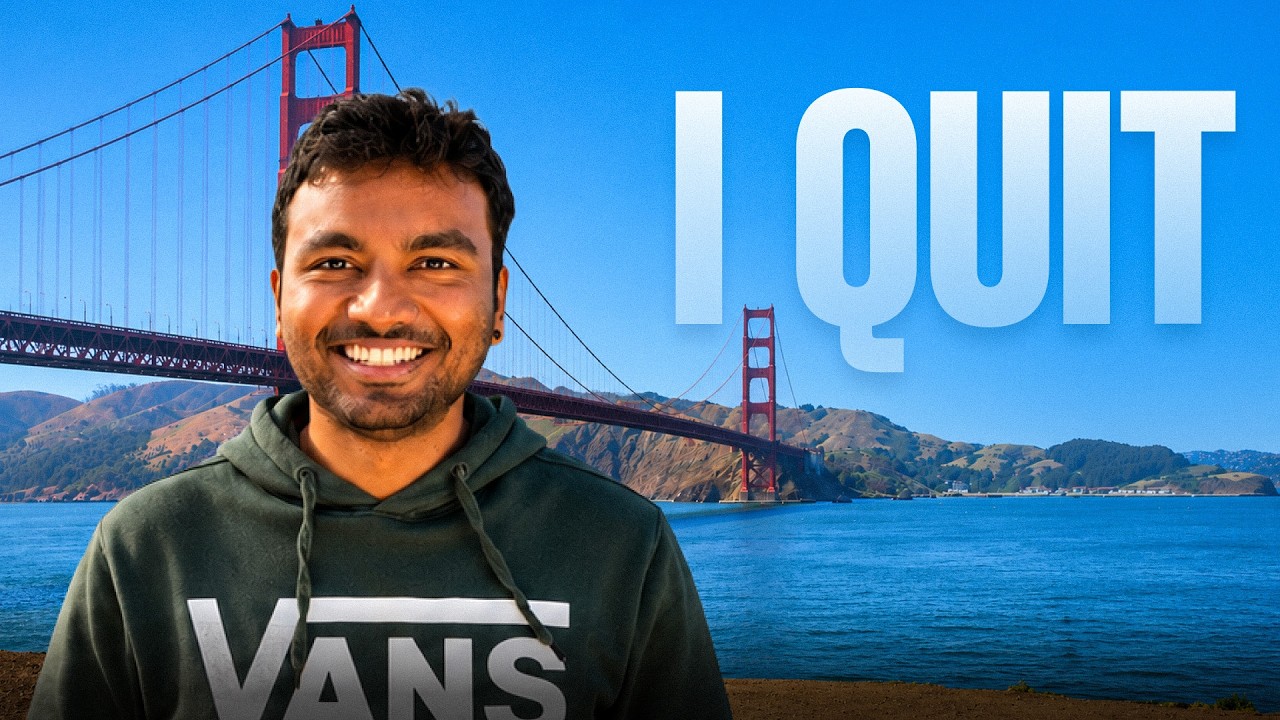
In this video
After more than a decade as a software engineer at Amazon, Salesforce and Nextdoor, Magesh left tech to run Hobby Fit Club, his online strength training program, full time, and to keep making YouTube videos. He explains why "follow your passion" is bad advice, how strength training and therapy got him through a low point, and how he earned his personal trainer certification, coached at a gym in San Francisco before his tech job each day, and tested paid online classes with his YouTube audience before quitting. Hobby Fit Club now runs about 19 online classes with four coaches he hired and trained. His advice: don't quit from something, quit into something you have already tested.
Key takeaways
- "Follow your passion" is bad advice. Nobody cares about your passion. Find something people will pay for.
- Strength training and therapy helped him through a low point. Two strength sessions and one therapy session a week, about 3 hours, were the best investment he made.
- He got certified and coached before he quit. He passed the National Academy of Sports Medicine's Certified Personal Trainer exam and coached at Strength Camp in San Francisco, at 5 AM, before driving to his tech job.
- He tested demand with paying customers. People who knew him from YouTube paid for live online classes and showed up two or three times a week.
- Hobby Fit Club is real now. About 19 online classes, 697 class attendances so far in 2026, and four coaches he hired and trained.
- Quit into something, not from something. Test the new path while you still have your job, build the skills it needs, plan your financial runway, and talk honestly with your family.
- The channel continues. More fitness, building Hobby Fit Club in public, and life as an Indian-American creator in the Bay Area.
Chapters
- 0:00Preview
- 0:18Why I Made This Video
- 0:33Meet Your Coach
- 0:56The Problem with "Follow Your Passion"
- 1:13Inside Hobby Fit Club Today
- 1:42Successful on Paper
- 2:20Therapy
- 3:11From Employee to Fitness Coach
- 4:31Living Two Careers at Once
- 5:07How Hobby Fit Club Was Born
- 5:57The Biggest Decision of My Career
- 6:57Rediscovering My Identity
- 7:26The Future of Hobby Fit Club & Hobby Explorer
- 8:36Don't Quit From Something, Quit Into Something
- 9:40Thank You
Frequently asked
Why did Magesh leave his tech job?
Hobby Fit Club, his online strength training program, had paying clients, coaches and classes that needed his full attention. He says he didn't leave because tech was terrible, but because he found a problem worth solving: the health of overworked employees.
How should you decide when to quit your job?
Test the new path while you still have your job, build the skills it needs, get real paying customers, plan your financial runway and talk to your family. Quit into something that is already tested, not into nothing.
What is Hobby Fit Club?
An online strength training program with live classes on Zoom, built for busy people with jobs and kids. It runs about 19 classes with four coaches.
Transcript
0:05 Hello explorers, I have some spicy news for you today. After a decade of working in Silicon Valley for tech companies, I quit my tech job to pursue fitness coaching full-time, building Hobby Fit Club, and to make some interesting YouTube videos. That is quite a lot to unpack. So, in this video I'm going to explain why I left my tech job, and if you're planning to quit your job, how should you do it? And what am I planning to do next? Why fitness coaching? And what is next for this YouTube channel? There are about 1.1 million subscribers, and I guess I owe an answer to all of you guys.
0:34 If you're new here, welcome to the channel. My name is Magesh, and I worked for tech companies like Amazon, Salesforce and Nextdoor for more than a decade, and I went through two acquisitions and one IPO. I was at Nextdoor when the company went public. So, that is 10 years of writing code, building products and attending meetings.
0:48 This is not a decision I made yesterday. I left some time ago, but I didn't want to show up here and make a dramatic video saying, "Quit everything and follow your passion." Follow your passion is very bad advice, in my opinion. In fact, nobody cares about my passion or my YouTube channel. In fact, you don't even care about your own passion or YouTube channel. I'm pretty sure you're actively thinking about these three things right now: How do I survive in this world? How do I find a partner and make babies? The sooner you realize this, the sooner you can make amazing decisions in your life.
1:13 Okay, so before I explain why I quit my tech job, a quick introduction to what I do now. I run Hobby Fit Club. It's an online strength training program. We run about 19 classes online, and so far this year, in 2026, we've had about 697 attendances. These are real clients trusting us with their health and attending the strength training classes every week. And I've hired and trained four amazing coaches who also run the classes alongside me. So, yeah, it's not a proof of concept anymore. It's already a huge responsibility.
1:42 For about a decade, I was doing amazing. I had my master's in computer science, a great career, respectable companies, amazing Bay Area weather. Well, on paper, I should be happy. But there was a point when I was extremely down. For a problem like that, I'm not pretending that I have a universal solution, but two things definitely helped me: strength training for my body and therapy for my mind.
2:03 The company I worked for at the time, Nextdoor, sponsored these therapy sessions. There were about eight or nine sessions every year that you get, and then it gets replenished. I was able to find an amazing therapist here within the United States. I'm always grateful for a company which pays for employees' therapy. I attended about one therapy session per week and two sessions of strength training. I also got a coach. I found a coach in San Francisco. I attended Zoom training sessions. It was around COVID time.
2:22 And just these three things: two strength training sessions every week and one therapy session every week. It's about 3 hours of investment. That's the best 3 hours I would ever invest every week for someone in that position. My therapist wasn't trying to fix everything by Monday morning. She would give me one small task that she wanted me to try that week or the next week, and slowly I got out of that phase. Once I got out of that phase, I felt this enormous amount of energy, and I felt like I wanted to give back to society.
3:00 That's when I started the YouTube channel, and people genuinely noticed that. The channel blew up. It went from zero to 100,000 subscribers in 25 days and 1 million subscribers in 18 months. So I started thinking, what if I could help people experience some of what I experienced through strength training? It's not a replacement for therapy. I have a lot of respect for therapists, and if you're thinking about studying psychology, you should go ahead. A lot of people need help, like me. But I had a lot of interest in fitness training.
3:25 Here in the United States, if you want to become a fitness trainer, there are exams for that. So I started studying for these exams. One of the main ones is the National Academy of Sports Medicine's Certified Personal Trainer. There were days that I would just wake up, study and go to sleep. Wake up, study and go to sleep. And finally, I passed all these exams and applied to a bunch of gyms here in the Bay Area, and I got a real job in a gym. It's called Strength Camp in SF, and I found a really good mentor there. His name is Jeremy. Thank you, Jeremy, if you're watching. He taught me how to coach real people and correct their form safely, how to run a class, how to open a gym, how to close a gym. Yeah, and that also includes cleaning the toilet floor at 5:00 a.m. So, yeah, I was really happy. I was learning everything there is to learn about fitness and running a gym.
4:07 And then one day a client walks up to me in the gym at the end of the class and says, "I had a really good session. Thank you, coach." That one sentence. You see, for most of my adult life I'd been a software engineer, and now people are trusting me to lead their training program, and people are calling me coach.
4:22 Everything else stays the same. Any questions? That is also 10 reps. All right, let's go.
4:31 For a stretch I was living two completely different lives. I would wake up at around 4:45 a.m., drive to my gym, turn the lights on, coach three classes, and then drive to Sunnyvale for my tech job, sometimes changing out of my gym clothes inside my car. Welcome to my luxurious changing room. Excellent lighting, but zero privacy. I would put on a fresh shirt, walk into the office, and become a software engineer. I would work till 6:00 p.m., and then I would drive all the way to my home in San Francisco, arriving around 8:00 or 9:00 p.m., completely exhausted. Then I would do the same thing again the next day.
5:02 ...at all times, and drive the knees away from each other.
5:06 That routine was hard, but it was so valuable, because my tech job was paying the bills and my gym shifts were giving me real-life coaching experience. And around that time I was thinking: I have a YouTube channel that I had almost forgotten about, a pretty large one actually. So, what if I told my subscribers that I became a fitness coach and started offering live online strength training classes? So, I tested it. I started running classes online, privately, and people joined.
5:30 People who had only known me through the YouTube channel actually scheduled calls with me, asked questions, paid for the classes and actually showed up for the classes. This is not like clicking like on a YouTube video. They were actually showing up on camera on Zoom, along with their busy lives, kids, jobs and everything they were juggling. They were showing up two to three times a week. I mean, these are not fitness people. They are regular, normal people who have a tech job.
5:53 And that's when I realized I have something here, and I need to take it to the next level. At some point I realized I was stretching myself too thin. I could try to do both and do a bad job, or choose one and give it all the attention it deserves. Trying to make YouTube videos while having a tech job is already hard, but it's doable. You could write the script at night and film over the weekends. But fitness coaching is different. Real people are waiting for you to start the class at a specific time. My coaches need training and members need support. The classes need to be programmed. That is a big responsibility that I could not treat like making a YouTube video. It's not a side hustle anymore. So, I decided to leave.
6:28 I mean, to be clear, I didn't leave tech because tech was terrible. Tech was great. Tech gave me financial stability. It taught me how to build products. And if there's one key takeaway from my tech career, I would say it is thinking in systems. Tech companies do that really well, and I'm grateful for the career. I left tech because I found a problem that is worth solving.
6:48 And tech companies have been ignoring this for a long time because it does not bring shareholder value: their employees' health. Everyone is overworked and anxious all the time. But it was still a serious decision. I gave up my predictable paycheck, my 401(k), food, the stability, and an identity that I spent like 10 years building. I mean, for a long time, if somebody asked what I do, I'd simply go, "software engineer." Now, it's more complicated than that. I'm a fitness coach, a content creator, and apparently I'm also the unpaid software engineer for my own company. I mean, hobbyfitclub.com is built entirely by me. Right now, I'm the product manager, designer, software engineer, and customer support. So, I didn't exactly escape tech. I just became the entire IT department.
7:26 All right, so the plan next is to build Hobby Fit Club responsibly. Most of my clients have jobs, kids and long commutes. Their lives are very busy. They don't need a 6-day plan. They need a highly structured 2-day plan that they can actually come back to, a system they can come back to and work out week after week. I mean, anyone can sell a fitness program. The real challenge is building something that people enjoy coming back to.
7:50 So, what's next on this channel? Hobby Fit Club is part one, and part two is YouTube, which will continue to happen. I started making YouTube videos with one person in mind, and I still think that one person is you. I'm making this video for you, and that will still be the case. If I were to define this channel in one word, I would say curiosity. That is still the same, and I'm still making the videos for you. But we still need to define some content pillars. So I would say there will be more fitness videos, there will be more about how I'm building this company, building in public, and there will be some lifestyle: Indian-American life, how life is in the Bay Area, and how my life is as a content creator. Generally, I feel like I've now left a safe path for a rough path. How is this path going? I'll talk more about that as well.
8:35 Here's the most important part of the video. Don't quit your job because you had a terrible Tuesday, or because someone on the internet said, "Oh, quit your job and follow your passion. Escape the 9-to-5." I didn't quit my job and then go looking for a purpose. I actually found something meaningful first, then passed my exams, trained for it professionally, got real-world experience as an employee, and then got some real paying customers who would pay for that service. Only then did I quit my job.
9:02 So, before you quit, test the new path while you still have your current job, and build some skills that are actually needed for the new path. And don't follow your passion. Follow up with the new customers. If somebody is willing to pay for your service, I think you've found your product-market fit. Also think about your financial runway. Don't create a financial emergency and call it entrepreneurship. If you have a family, talk to your family honestly; your decision also affects your family. And I don't think you can quit into nothing. You have to quit into something, and that something has to be tested before you quit.
9:32 And my decision wasn't like, "I'm tired of tech and I'm escaping." It's more like: people are trusting me. This program works. This deserves my full attention. And finally, to everyone who watched some of my early videos and shared them, and stayed even when I disappeared for a while: thank you so much. You gave me the freedom to explore. Now the real exploration begins. I'll see you in the next video.
Source: YouTube auto-captions, edited for readability (filler words removed, names corrected).