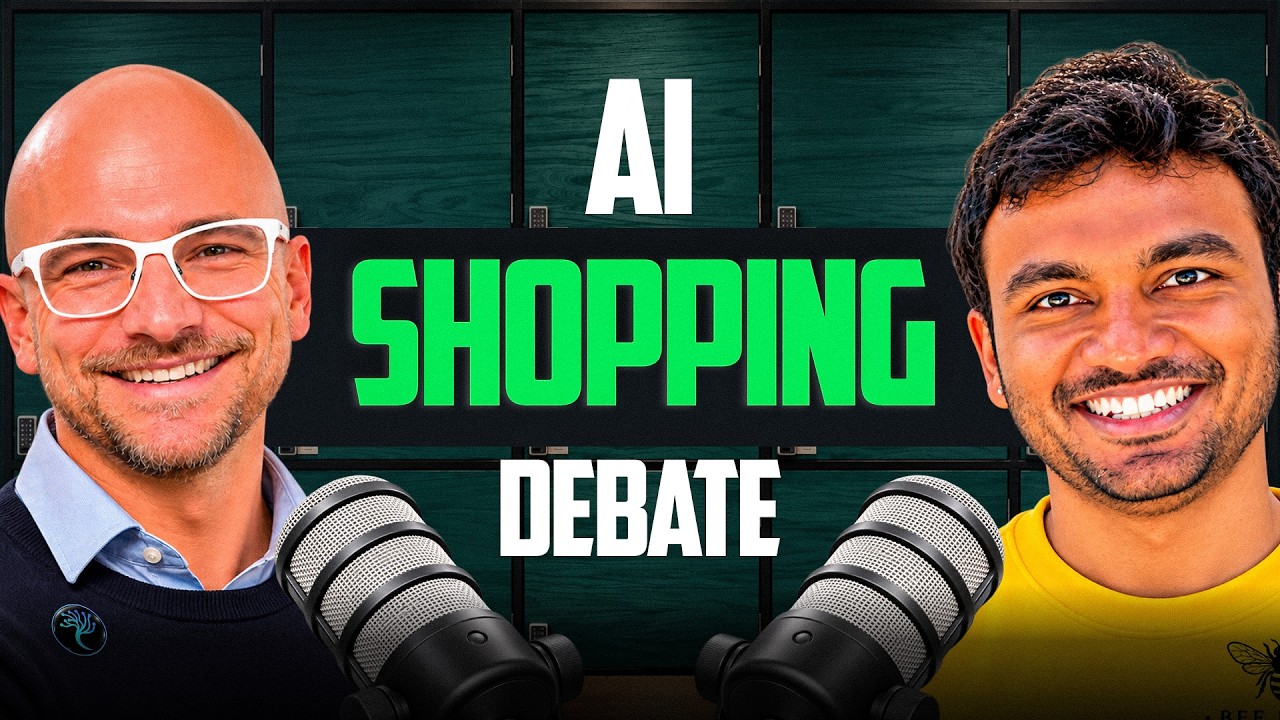
In this episode
Founders Debate #1, an Oxford-style debate recorded live in San Francisco and moderated by Igor Sokolov. The motion: "This house welcomes AI agents shopping on behalf of humans." John Lunsford, founder of Tethral, argues for it: agents save time, catch sales and limited releases when you can't, and make shopping accessible to people who can't get to a store, including older people who want to age in place. Magesh argues against: online shopping already flattened a multisensory experience, and an agent built to close the sale flattens it further. He worries about losing everyday judgment (his "paper towel judgments"), products designed to win reviews instead of serving different people, impulse buying, and small sellers paying for returns that end up as trash. Three rounds of rebuttals and closing statements follow, and the room votes before and after.
Key takeaways
- The case for, in three parts. John: agents save time, act on price drops and limited releases when you're busy, and make shopping accessible to people who can't get to a store or a checkout.
- The case against starts with a perfume shop. Shopping used to be multisensory. Online made it two-dimensional, and an agent asked to "get a perfume for $100" makes it one-dimensional.
- Agents are built to close the sale. Magesh bought a $60 Peak Design phone tripod after taking his time; he argues an agent would have bought a $20 one from Amazon, and wouldn't wait a day to keep exploring.
- Sensory overload cuts both ways. John finds perfume shops overwhelming and sees a middle ground where an agent narrows the choice based on your history before you shop.
- Paper towel judgments. Delegating everyday purchases could erode judgment, the way GPS did for directions, especially for a student buying toothpaste for the first time.
- Old problems with a new hat on. John compares this to industrialization and the later return of craftsmanship, and argues the way to ask the hard questions is to let AI take on some of these tasks.
- It's so easy to say yes. After Grok ordered his food through Uber Eats, it offered to repeat the order every Friday. Magesh said yes, and worries agents will make us buy more.
- Sellers carry the risk. One in five products is returned and many returns end up as trash. Small sellers already pay for returns and aren't ready for AI buyers making mistakes.
Chapters
- 0:00Trailer
- 0:47Welcome and the motion
- 1:51Opening statement: John (for)
- 4:01Opening statement: Magesh (against)
- 5:57Rebuttal 1: John
- 8:35Rebuttal 1: Magesh
- 10:38Rebuttal 2: John
- 12:18Rebuttal 2: Magesh
- 13:44Rebuttal 3: John
- 15:14Rebuttal 3: Magesh
- 16:34Closing statement: John
- 18:37Closing statement: Magesh
- 20:07The final vote
Frequently asked
What is a Founders Debate?
An Oxford-style debate hosted by Hobby Explorer in San Francisco. Two speakers take opposite sides of one motion, give opening statements, rebuttals and closing statements, and the audience votes before and after.
What are the arguments for AI agents shopping for you?
John Lunsford argues they save time, can act on sales and limited releases when you're busy, and make shopping accessible to people who can't get to a store or a checkout, including older people who want to take care of their own groceries.
What are the arguments against AI agents shopping for you?
Magesh argues that agents reduce shopping to a single dimension like price, are built to close the sale, can erode everyday judgment, push products designed to win reviews, make impulse buying easier, and leave small sellers paying for more returns.
Transcript
0:00 …agents can grab it for you. It would have bought a $20 product from Amazon for sure. AI agents should be able to shop for us. Who loves waiting in line? Nobody likes waiting in line. I am speaking against. An AI agent always has one task: it needs to close the sale. Can you get a perfume for $100? That's it. It is just now one-dimensional shopping. Not everyone has the capability to go to stores physically. One in five products go back. A product that is going back is usually going back to trash. These are old problems with a new hat on. Age in place gracefully, where I can take care of my own groceries. Why do we have to make it hard for them? It's so easy to say yes. Do I really need that every day? The future of agentic shopping is actually very promising. The house is going to decide who is the winner.
0:47Igor: Welcome everyone to the first ever Founders Debate. I'm really happy you came here. I'm Igor. I'm hosting tonight. If anyone is listening to us on Spotify: if you ever hear a chime sound, that means you're welcome to look at your screen for some visual content. Today's motion: this house welcomes AI agents shopping on behalf of humans. Debating for, John Lunsford, founder of Tethral AI. Debating against, Magesh.
1:14Igor: Debaters speak for three minutes, first for the opening, then they will have two rounds of rebuttals, and three minutes for the closing statements. The house is going to decide who is the winner, and we will do that with two votes. Go ahead and scan the QR code. Vote yes, they should, or no, they shouldn't. Thank you. So far, many of you are for AI agents shopping on behalf of us. Let's begin the debate.
1:40John: Thank you so much. AI agents should be able to shop for us for three different reasons. One is time savings, another is price sensitivity, and the third is accessibility. Now, when we talk about time savings: who loves waiting in line? Everybody? Wait, no. Nobody likes waiting in line. You're waiting to get the thing that you want, not getting the thing that you want.
2:02John: When you're allowed to have an agent that can act on your behalf, not just now, maybe even in the future, you have the ability to shop for the things that you'll want when you want them, without having to wait in line. That frees up time so you can spend time on the things that matter more to you, whether that's sitting at home on your couch playing video games, going on a trip, or spending time with your friends. So it unlocks time. Now, price sensitivity. We've all had items that we wish cost less. Often you don't get the sale, and so now you're either stuck without the thing you want or need, or you're paying full price. That is not a great user experience. But it's not your fault. You were doing something: you had school, or you were at an activity, or you had responsibilities.
2:49John: Imagine an agent that was poised, ready to take action when the merchant dropped the sale, when your shoes were finally released on shelves, or when you needed that one thing to create the perfect recipe for the perfect date night, only available one time a year. So, availability and price sensitivity: agents can grab it for you. The other thing that is important to me, as I get older but also as we're exposed to more of the world around us, is accessibility for shopping. Not everyone has the opportunity or the capability to go to stores physically, or they may not have the technology that lets them visit digital checkout lanes. So regardless of whether your connectivity is good or not, you can still delegate this authority to an agent and say, go check out for me, even when I'm not available, even when I can't go myself. It still gives me the feeling of control and power to age in place gracefully, where I can take care of my own groceries.
3:51John: Even with just those three, and there are plenty more, I think those present a rounded articulation of why the future of agentic shopping is actually very promising. Thank you.
4:01Magesh: Before I counter the arguments, I would like to present an opening statement, my own thoughts, before we start the rebuttals. I am speaking against AI agents shopping on behalf of humans. I want to start with a story of how you would shop for a perfume. Imagine you're walking into a store, before online shopping. That's how we were shopping for things, right? We would walk into a store. Perfume stores are amazing to look at. There's this huge array of things displayed there, and there's a shopkeeper, who is mostly a welcoming person. They will hand you a small strip of paper, spray a sample of the perfume on it and give it to you, and you would smell that small sample and make a judgment.
4:44Magesh: Is this a perfume that I want to wear for the next 30 days? Maybe your partner is next to you, and they're also making a selection: "Eh, I don't like this." You might like it, but if your partner doesn't like it, that perfume is not going to sell, right? And then what happens? The shopkeeper hands you a jar of coffee beans to clear your pathways, and then you smell another perfume. We lost all of that when we moved online. Shopping for perfume used to be this multisensory, multi-dimensional experience. We moved that online to a two-dimensional shopping experience. How do we judge a perfume by just looking at the bottle? We already lost a lot of dimension there. And when we move on to this new thing, AI agents shopping for us, we are losing one more dimension.
5:33Magesh: It is just now one-dimensional shopping: can you get a perfume for $100? That's it. We are losing a lot of experience here, a lot of that high-fidelity experience. My argument is also in three parts.
5:46Igor: 20 seconds.
5:48Magesh: All right. I'll save the rest of the parts for later. But I want to talk about the seller side of things as well. There are a lot of returns that the sellers are paying for.
5:56Igor: Great opening. Thank you, Magesh.
5:57John: Sensory experience is a really strong position to come out with against AI agents, because you're right: there are things that AI agents aren't going to do well for you, where you are then at the mercy of either the agent's description or even the merchant's description. How do you describe a perfume to someone in a way that they'll experience it? I would also like to counter that experience with when I walk into a perfume shop.
6:19John: I have a very sensitive sense of smell, and so I am assaulted with this overwhelm of sensations. I can't distinguish one from another. Not only am I not able to understand the smells of the perfume that I'm supposed to appreciate, I am now stressed out and aggravated, and maybe I snap at my partner, who did nothing wrong other than go perfume shopping with me. I think it would be highly specific to the individual. I'm not saying that AI agents take over all the shopping we ever have to do. There's an important performance of care that we do with shopping, when we shop for friends or loved ones. But when I'm shopping for my coworker, I could automate that, and that would be fine with me. And as far as over-sensory experiences, I think there's a really interesting middle ground that we haven't achieved yet, that could be agentically inspired, that allows a certain selection of perfumes based on my history or my preferences to come out, rather than being exposed to that whole experience all at once.
7:21John: And that's really where I wanted to center this. There isn't a one-stop shop that says this kind of agentic purchase is going to solve everything for everybody all the time. That is a world where we don't really participate. But what I think is really powerful about AI agents, going back to some of my own examples, is the opportunity for us to intervene at key moments, to spend time on the things that matter. If shopping for perfume or wine or any of those experiences with a partner is as much about spending time with that person as it is about the thing you're shopping for, why jeopardize the goodness of that time by going to an experience that's going to be overwhelming? I would argue that we need to not deny the ability to do some things remotely that could be out of our comfort zone, away from experiences that would negatively impact us, while still enabling a certain amount of agentic capability that allows us as individuals to choose where we want to spend our time, not just be forced into it.
8:27Igor: Thank you, John. John described the shopping experience as, for some, difficult, nightmarish. How do you respond to that?
8:35Magesh: I would like to open with an agreement, actually. The point about aging peacefully, I definitely agree with that. It is definitely a convenience for people who cannot go out all the time or be in control all the time. It's going to be helpful as an accessibility feature. We shouldn't make an accessibility feature the default for everyone; that's what I'm afraid of. For example, I wanted to purchase a small tripod that attaches to a phone. If I gave that task to an AI agent, it would have shopped for price: what is the most cost-effective way of purchasing this small tripod that attaches to a phone. To your point about AI being cost effective, maybe that's not what I'm looking for. I'm trying to venture into a small hobby called video creation, and I might need to spend a bit more time understanding what this tripod is going to do for me.
9:26Magesh: As a creator, these tools matter to me. I'm going to use these tools to work on something, so I should spend a bit more time. Maybe cost effective is not the way to go here. I ended up purchasing a $60 small tripod, actually. It's an expensive one for a phone tripod, but I even got a lot of compliments from other creators: "Hey, I've never seen a tripod so thin." It is made a couple of blocks from here, by Peak Design, one of the most expensive ones. I don't think an AI agent would have made the decision to buy a $60 small tripod that attaches to a phone. It would have bought a $20 product from Amazon, for sure. That's my argument. One more thing: I might not even be looking to close the sale. An AI agent always has one task: it needs to close the sale.
10:13Magesh: It's designed for that. But sometimes I might not be willing to close a sale at that point. I might be experiencing that shopping and want to spend some more time. So today is not the day we are closing the sale. Maybe it's going to take one more day of exploration before that shopping is finalized. An agent is not going to be patient like that. It's going to close the sale as soon as it makes a decision.
10:38John: I really like that you brought up the quality of the agent experience. I think that's also what sets apart now from 10 years ago. AI is not a new phenomenon. Agentic AI, or LLMs, or neural networks as we think about them now, that can reason about behavior, are very different from the machine learning models that were deployed, let's say, in the early 2000s to push people into purchasing.
11:05John: I'm not saying that can't be abused, with a convincing LLM that presents something beautifully, but we also have the opportunity to build in a different direction: a direction that incentivizes user experience, whether that's the buyer or the seller, to try to get what those users need from that particular experience. Maybe it's a quick sale. Maybe it's eliminating the length of time an item spends on a shelf, so that a merchant can move through it more quickly, which you get with agentic purchasing, because you're not waiting for a consumer to come in and make a decision. You only encounter things when they're ready to make decisions. From the user's standpoint, having the flexibility to be able to say, "Actually, I changed my mind. I don't want to be price sensitive.
11:51John: I thought I was, but I'm not. I need to feel what this matte feeling is like, or I need to hold it in my hands." I do that with keyboards all the time. It's got to be about feeling. It can't be about a picture. We do need to take that into consideration as we navigate these experiences. But what better time than now to do that, with machines that can collaborate with us in our thinking, if it's done right?
12:13Magesh: I don't have an exact answer to that. But I would like to start another argument. You talked about shopping for quality, right? There's another kind of product that we shop for that's not about quality. It's just a commodity, like toothpaste or paper towels. These are repeat purchases. I understand a lot of people might be willing to delegate that task to an AI agent, and then we lose the ability to make the judgment at all: is this a good deal or not? We currently possess that judgment and the ability to make that call, and over time, if we delegate our paper towel judgments to an AI agent, we'll slowly start losing all those judgments. That happened with GPS. When we got GPS, we used it all the time, and now we don't know how to get home. I don't know how to get home from here. Another thing: a kid might be going from high school to college. For that kid, making a toothpaste judgment is actually new. That kid was given toothpaste by their parents all their life. Now, for the first time, in their college dorm, they're making a judgment about what toothpaste they should be buying. It is a commodity, but for that person,
13:20Magesh: it is not a commodity. It is something new. Do I like this toothpaste or that toothpaste? Am I spending too much on toothpaste? These are things that humans should be deciding. It's part of growing up. They're throwing a party: what kind of paper towel do I need? Double ply, single ply? I don't know. These are things that I should be experiencing. We don't want to rob them of that experience as they are coming of age.
13:42Igor: John, Magesh is saying that maybe it's dangerous.
13:44John: First, I just want to earmark "paper towel judgments." I love that sentiment. I think that is an amazing way to articulate seemingly mundane judgments, when we talk about important moments of coming of age. But from a top-down perspective, it's just paper towels or toothpaste, or walking to the store by yourself for the first time. So how do we marry those two worlds? This one, where we increasingly try to automate the tasks that we know as adults are less important to us. But do we then automate those tasks for people who haven't figured out what's important to them yet? I think that's a key question that we need to be asking today. But the only way we can ask it is in conversation with the AI that can also take over some of those responsibilities. Because the other side of that is: why put our children, or our children's children, through the same negative experiences, the same trials that we had?
14:40John: Certainly they'll find their own. That's part of growing up. But why subject them to... I don't know if you've heard the phrase about walking barefoot in the snow, uphill both ways, to get to school? It was a joke parents would tell their kids about how hard it was the generation before. But why? Why do we have to make it hard for them? Why can we not present them with this set of tools and still teach discernment about when to use them and when not to? It's not only a beautiful sentiment but a crucial question that we can only ask if we allow AI to start taking over some of those responsibilities.
15:14Magesh: That is a good one. I hear what you're saying. I don't have a counterargument for that, for sure. I'm pretty sure they'll have their own experiences. Another point I noted down is about reviews. My way of thinking about what an AI agent would do if I delegated that task to it is: how good is that product? How are the reviews? We all know how the review system currently is. The reviews are written by people who bought the product, and it worked well for them. It might not work for me. I have to spend more time reading the product description, maybe see a video of the product, see somebody using it, go online and watch a review on YouTube from someone professionally reviewing the product from multiple angles. That's how I make a decision. It's not just "it's 4.7 stars, it must be good." It may or may not work for me.
16:02Magesh: That's when I feel like we are going to have a sameness of products that might discourage entrepreneurs from designing new products for new people. We could have this "everything is made in one factory" thinking, that it could work for everyone. The world is already dominated by right-handed products; we're not spending time designing left-handed products. What if we end up with that kind of problem, where products are not designed for a diverse set of people, and instead it's just review gaming? The AI is making all the decisions, and the designers are working round the clock to make sure the AI makes the purchase decision.
16:34John: I first want to acknowledge Magesh's points here. I think they are crucial ones that we need to approach with our eyes open. I want to challenge that many of these are old problems with a new hat on. Think about the move from carefully cultivated craftsmanship to industrialization, when things became the same but cheaper, and consumers started getting the exact same toys over the exact same days over the exact same year, and then we had this reemergence of craftsmanship. There is an ebb and flow of society adjusting to those things. But the best thing we can do is to approach this new moment not with our eyes closed, hoping it doesn't happen, but rather saying: yes, let's accept that AI can operate agentically in these ways, but what are the questions, what are the things we should be asking while it does? I'm not saying that we need to accept everything it hands us, or that we need to stop thinking for ourselves, because that muscle is so important: being able to discern what is or isn't a good product, or is or isn't a reliable review, even if it's honest. Understanding what has been done before is a great pathway for navigating our new experiences with AI. For the end of this very fun conversation, what I can take away is that we need to think about the things that have been pitfalls or hurdles for other similar patterns of technological emergence, where other things like this have come out and people have struggled with them, and we look at those and learn from them.
18:18John: It's not that we don't need to make mistakes. We will. But as we do, we can grow in a direction that we're more aware of, that doesn't just happen to us. Not to belabor the point, but I think we can only do that if we allow AI to start interacting in new ways and to start challenging our old relationships with the world.
18:37Magesh: Recently I ordered food through Grok, and it placed an order through Uber Eats. At the end of the task, it offered: "Do you want me to do this every Friday? I will automate it for you." And I said yes. If I think about it, it's kind of making me consume more. Do I really need that Friday breakfast surprise every day? I only wanted to do it on Thursday, just a one-time thing, but it offered and I took it. I'm afraid we might see more of that. It's so easy to say yes.
19:03Magesh: In the end, we may not even need the products it's offering us to buy. If we think about sellers: people are selling products on all kinds of platforms, like Amazon, Shopify and Walmart. Many of the American sellers I'm seeing are small business owners, and they could be disproportionately affected during this transition period of AI starting to shop on behalf of humans. They're already faced with a lot of returns: one in five products goes back, and a product that goes back usually goes to the trash. If AI makes mistakes in purchase decisions, those returns are total waste. Right now the sellers are paying for these returns. These sellers are small business owners, and they are not ready for AI. They are still struggling with bookkeeping and accounting, and their profit margins are so thin. Shopping is not just "I give you money and I get the product."
19:51Magesh: Most of the time it could be a community thing, like going to a shop with your family. I remember spending time with my parents and my brother in a place where we would go shopping for clothes for festivals. I don't want to lose all that. That should continue to be a human experience. That is my closing argument.
20:07Igor: Okay. So now we're done with that part of the debate. Give a round of applause for our speakers. Thank you so much. Now we're going to the next vote. Everyone who voted the first time, please vote again. It looks like it's pretty much a stalemate, which is exciting. We will have more of these debates; there's the link you can scan.
20:40Igor: The next topic is still up to us. It will be on November 5th at 6:00 p.m., here. So this was the very first Founders Debate. Thank you so much for participating. My name is Igor, and I was hosting today, and you're welcome to pick a friend next to you and start arguing with them.
Source: YouTube auto-captions, edited for readability (filler words removed, names corrected, speakers labeled).


